
Building systems that are ready to operate
We design and implement systems with clarity and control, so they can be understood, supported, and maintained over time.

What this covers
Build focuses on putting the right foundations in place before systems become difficult to manage.
Infrastructure setup
Cloud, on-premise, or hybrid environments configured with reliability and future operations in mind.
System implementation
Core platforms, services, and integrations set up with clear ownership and manageable dependencies.
Operational readiness
Documentation, access, monitoring, and handover prepared so systems can be supported properly.
How a typical environment is structured
A well-built environment can span on-premises infrastructure, private cloud, and public cloud. The goal is to keep each layer connected, resilient, secure, and manageable over time.
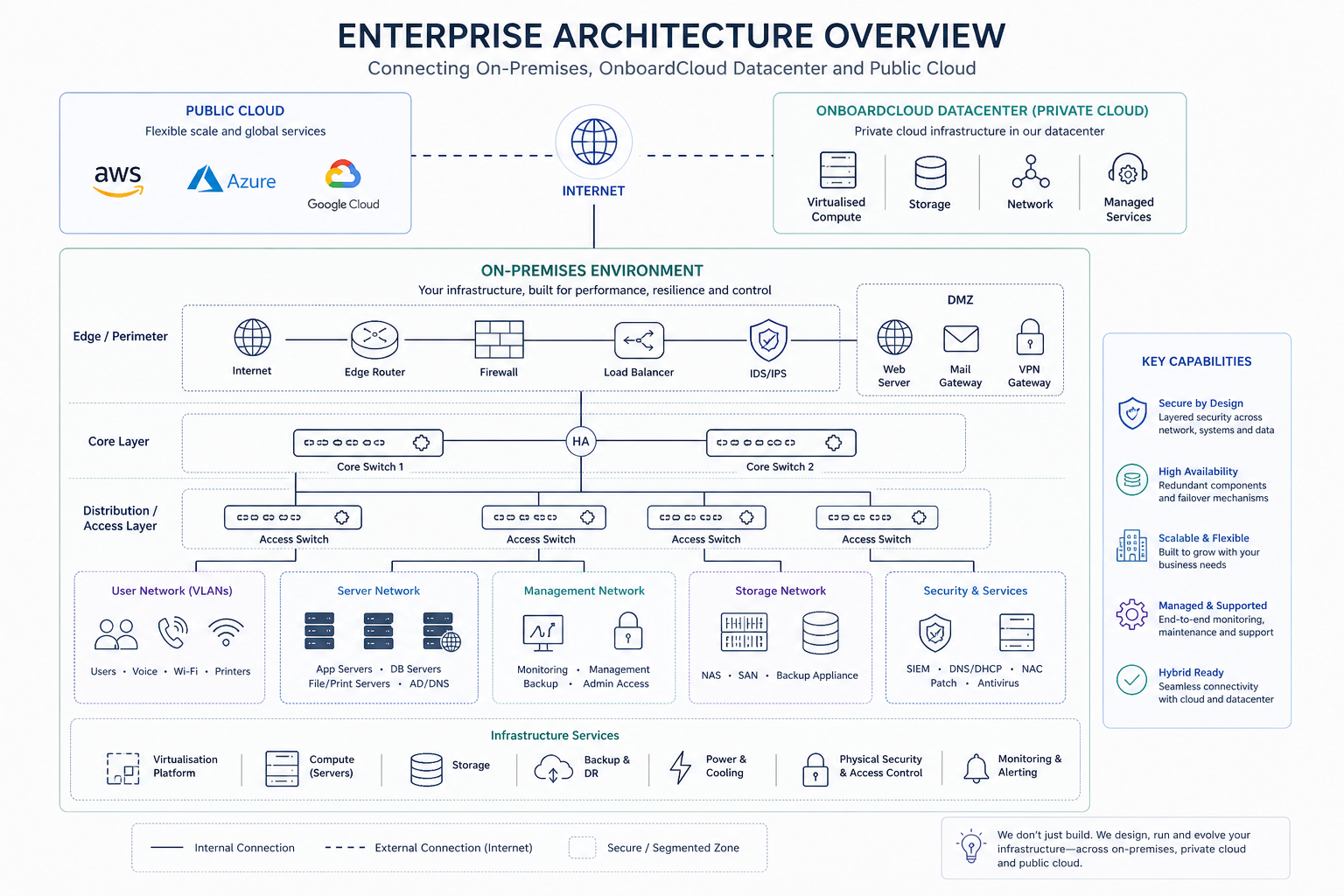
This is a simplified reference model. The exact design depends on scale, risk, budget, and operational needs — but the principles remain consistent: clear structure, controlled connectivity, resilient components, and ongoing support.
Technical foundations we commonly build
The exact design depends on the environment, but these are common areas where build quality has a direct impact on reliability and supportability.
Compute & virtualisation
Servers, hypervisors, clustering, resource planning, high availability, and workload placement.
Network foundation
Routers, switches, VLANs, routing, Wi-Fi, firewall integration, segmentation, and remote access.
Availability design
Redundancy, failover, load balancing, backup paths, capacity planning, and recovery considerations.
Storage & backup
NAS, SAN, shared storage, snapshots, replication, backup design, and restore validation.
Cloud & hybrid connectivity
Cloud landing zones, identity integration, secure connectivity, monitoring, and hybrid architecture.
Operational readiness
Documentation, access control, monitoring, patching approach, handover, and support model.
How we approach build
The objective is not to add complexity. It is to create systems that can be trusted and maintained.
- Clear foundation
We define the purpose, dependencies, and operating model before implementation. - Supportability by design
Systems are built with monitoring, access, updates, and recovery in mind. - Controlled implementation
Changes are introduced in defined stages instead of large, disruptive shifts. - No unnecessary complexity
We implement what is needed, not every feature that is possible.
What this means in practice
A well-built system should reduce future friction instead of creating hidden operational cost.
Easier operations
Teams can understand how systems are put together and how to support them.
Fewer hidden dependencies
Design decisions are documented and easier to review later.
Better handover
Systems are not just delivered; they are prepared for ongoing use.
Less rework
A stronger foundation reduces firefighting and avoidable rebuilds later.
Planning a new setup or rebuild?
We can help put the right foundations in place so your systems are ready to operate and support.